
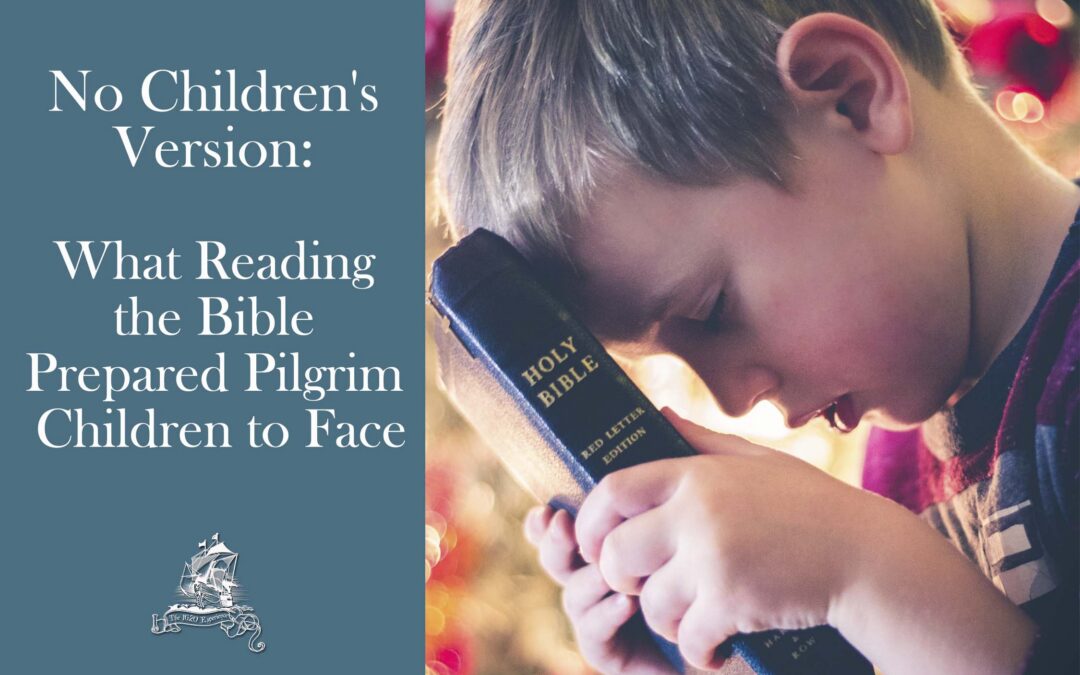
Imagine gathering your children to read Scripture in Plymouth Colony. There is no illustrated children’s Bible with the frightening parts removed. No simplified version that skips quickly from Noah’s animals to David’s victory over Goliath and then to the manger. The Bible your children encounter contains creation and covenant—but also murder, famine, slavery, war, persecution, betrayal, sacrifice, political corruption, execution and death.
It contains people who obey God and people who fail spectacularly. Leaders make terrible decisions. Families fracture. Nations suffer consequences. Faithfulness can carry a price. And then your children look up from the page.
Outside is Plymouth.
They have crossed an ocean. Many have buried parents or siblings. Food can be scarce. Adults become sick. Houses burn. Relationships with neighboring peoples can determine whether the settlement experiences trade, peace or conflict. For Pilgrim families, the Bible was not an escape from life’s difficult realities. It gave them a framework through which to understand them.
Pilgrim Children Really Did Read the Bible
We don’t have to speculate about whether Scripture was part of children’s education. Pilgrim Hall Museum’s research on books for colonial children states plainly that young children in seventeenth-century Plymouth Colony read the Bible and that most families owned at least one. Literacy had a religious purpose. Pilgrim and Puritan parents believed children needed to be able to read in order to understand Scripture.
Pilgrim Hall preserves William Bradford’s Bible, and its collection includes several important early Bibles. The Geneva Bible was the version most commonly associated with the Pilgrims, although John Alden owned both a King James Bible and a Geneva Bible. This was therefore not simply a society in which adults occasionally quoted Scripture to children. Reading Scripture was part of becoming educated.
There Wasn’t Much “Age-Appropriate” About the Reading
This is where the difference from modern childhood becomes striking. Pilgrim Hall notes that children’s literature as we understand it was only beginning to emerge. Children frequently encountered material written for adults. Even fables and myths were available in their uncensored adult forms.
Religious instruction wasn’t necessarily softened either. Pilgrim Hall describes Richard Greenham’s A Short Form of Catechising, a work explicitly intended to help parents teach their children. It used small type, difficult vocabulary and lengthy answers. The museum concludes rather wonderfully: “No concessions are made to the young or to beginning readers.” Older Plymouth children might also encounter adult books about history, geography, exploration and war. William Brewster’s remarkable library included Richard Hakluyt’s accounts of voyages, John Smith’s description of New England, and material concerning the wars of Swedish king Gustavus Adolphus.
Their intellectual world wasn’t designed around protecting children from the existence of danger. It assumed they were gradually being prepared to understand it.
And the Bible Wasn’t Sugar-Coated Either
Consider what a child actually encounters when reading Scripture. Noah survives a catastrophic flood. Joseph is sold by his brothers and later confronts famine. Moses challenges political power and leads a people through wilderness. Israel repeatedly experiences the consequences of collective choices. David demonstrates extraordinary courage—and later catastrophic moral failure. Esther must decide whether to risk her life by approaching a king. Daniel must decide whether obedience to God is worth political punishment. The apostles experience imprisonment and persecution. Jesus teaches mercy, sacrifice, forgiveness, courage and responsibility—and is crucified.
For Pilgrim parents, these weren’t merely exciting stories. They belonged to a theological understanding of human nature and responsibility. Pilgrim Hall describes their religious worldview as one in which Scripture was to govern belief, worship and conduct. Bradford himself described the Separatists’ desire to be ruled by the laws of God’s Word according to Scripture.
A child repeatedly encountering those narratives was therefore being introduced to a particular idea: Choices have consequences. Not only for the person making them. Sometimes for a family. Sometimes for a community. Sometimes for generations.
Then Life Reinforced the Lesson
This is where Plymouth becomes particularly interesting. Biblical accounts of danger, loss and human frailty weren’t abstract concepts to these children. During Plymouth’s first winter, approximately half of the Mayflower company died. Bradford recalled that at the worst point only six or seven people remained healthy enough to care for everyone else. Those few fetched wood, made fires, prepared food, washed clothing and cared for the sick while risking their own health. Bradford remembered their conduct as an extraordinary example of love toward their friends and brethren.
Imagine being a child witnessing that. The biblical command to love one’s neighbor is no longer merely a sentence. Someone has to get the wood. Someone has to make the fire. Someone has to feed the sick. Someone has to do the unpleasant work. Faith becomes action because circumstances demand action.
Scripture Also Gave Suffering a Story
Here we need to distinguish historical evidence from psychological interpretation. We cannot diagnose the emotional lives of children who died four centuries ago. Nor can we prove that Bible reading made a particular Plymouth child more resilient. Modern research, however, helps us understand why shared stories and family conversations can matter when children confront difficult realities. Research on family storytelling has found that stories can help families transfer beliefs and values, provide role models, approach difficult situations and encourage perspective-taking. More recent research examining storytelling and resilience found that children and parents associated shared narratives with qualities including hope, empathy, bravery, support and perseverance.
Research on parent-child conversations after traumatic experiences also suggests something particularly relevant: Open discussion can give children opportunities to process difficult experiences rather than simply avoiding them. In one study of 127 families following acute trauma, structured parent-child narratives generally produced low distress, while parents described the conversations as opportunities to understand children’s feelings and help them process what had happened.
We should not project twenty-first-century psychology backward and claim the Pilgrims understood trauma processing. They didn’t. But their children possessed something psychologists recognize as potentially powerful: A shared narrative vocabulary for talking about suffering, courage, failure, duty and hope.
The Bible Didn’t Promise That Good People Would Be Safe
This may have been one of Scripture’s most useful lessons in a dangerous world. The biblical narrative does not teach that faithful people are protected from every terrible event. Joseph suffers. Job suffers. David grieves. The prophets suffer. The apostles suffer. Christ suffers. Faithfulness and hardship frequently coexist.
For children living in Plymouth, that was painfully realistic. William Bradford himself had been orphaned as a child. Pilgrim Hall records that young Bradford turned toward Bible study and books and, by age twelve, was walking considerable distances to hear reforming preachers. The man who would later lead Plymouth had learned Scripture not from a life insulated from loss, but from within one that already contained it.
Family Faith Also Created Responsibility Beyond the Family
This brings us to an important question: How might this kind of formation influence civic responsibility?
The Pilgrims did not separate religious obligation from community responsibility as neatly as modern Americans often do. Their congregation understood itself as a community bound by religious commitments. Brewster served as Plymouth’s spiritual leader, preaching and teaching Scripture. His household included not only his own children but Richard More, one of several children aboard the Mayflower placed in other families.
After the first winter, surviving households absorbed children who had lost parents. The sick had to be cared for. Food had to be distributed. The settlement had to be defended. Disputes had to be resolved. Leaders had to be chosen. Plymouth’s survival depended upon people understanding that their choices affected other people.
That principle sounds remarkably like one of Scripture’s recurring themes: Individual conduct has communal consequences.
Modern Research Finds a Connection There Too
Again, modern studies cannot prove what happened psychologically in Plymouth. But they provide an interesting comparison. Research on young children’s moral development has found associations between parents’ religious understanding of parenting, positive moral socialization and children’s developing conscience. The researchers emphasize the family’s formative role in helping children develop ideas about right, wrong, helping others and repairing harm.
More recent research also finds connections between what families deliberately transmit and children’s later understanding of civic responsibility. A 2025 longitudinal study of adolescents found relationships among family cultural socialization, family-centered values, civic responsibility and prosocial behavior. Another 2025 study found that family discussions of social and political issues were directly associated with emerging adults’ sense of civic responsibility.
These studies concern modern populations very different from seventeenth-century Plymouth, so they should not be treated as evidence about the Pilgrims. But they reinforce a broader principle: Families don’t merely transmit information. They transmit frameworks for understanding obligation.
Perhaps That Was the Real Education
A Pilgrim child’s education was not designed primarily to produce a child who knew more facts. It was intended to form a person. Reading mattered because Scripture mattered. Scripture mattered because truth was expected to affect conduct. Conduct mattered because choices had consequences.
And in Plymouth, consequences were sometimes immediate. Don’t work, and necessary work remains undone. Don’t prepare, and winter still comes. Don’t care for the sick, and people suffer alone. Make a reckless decision, and your household may bear the cost. Break trust, and a tiny community has to live with the damage. Keep your word, and other people learn they can depend upon you.
This is where religious education and civic formation begin to overlap.
They Weren’t Preparing Children for a Safe World
Perhaps that is the greatest difference. Modern parents understandably want to protect children from things they are not ready to carry. But protection and preparation are not quite the same thing.
Plymouth families lived in a world where adults had very limited ability to remove danger from children’s lives.
So children encountered stories about danger. They encountered moral failure. They encountered sacrifice. They encountered death.
But they also encountered deliverance. Courage. Repentance. Forgiveness. Duty. Providence. Hope.
And they encountered those ideas repeatedly, inside families and congregations that expected belief eventually to become behavior. The Bible did not tell Plymouth’s children that life would be easy. Their own experience would have made that promise impossible to believe anyway. Instead, it offered them a much harder proposition: Life can be dangerous. People can fail. Suffering is real. Your decisions still matter. You remain responsible for what you do—and for how you treat the people God has placed around you.
For children growing up in Plymouth Colony, that wasn’t merely religious instruction. It was preparation for life. And, eventually, preparation for taking their own place in the community.
For the historical heart of the article, visit Pilgrim Hall Museum — Books for Colonial Children where the article discusses Bible reading, catechisms and adult-level reading. It is particularly strong because it explicitly documents that young Plymouth children read Scripture and that religious texts made few concessions to young readers.
For the religious framework, visit Pilgrim Hall Museum — Religion & Worship; for the lived reality of communal sacrifice, visit Pilgrim Hall Museum — Winter of 1621. Bradford’s biography is also valuable because it documents his own turn toward Bible study as an orphaned child, Pilgrim Hall Museum — William Bradford.
For the modern psychological discussion, the strongest links are the Study — Parent-Child Discussion Following Trauma and the Study — Parenting, Moral Socialization and Children’s Conscience Development. These links are provided as comparative research, not implying psychologists have empirically established the effects of Bible reading on seventeenth-century Pilgrim children.
Recent Comments