
Pilgrim or Puritan?
For generations, Americans have used the words almost interchangeably. Both groups came from England. Both were Protestant. Both established colonies in seventeenth-century New England. Both believed deeply in Scripture, emphasized moral conduct, and profoundly influenced American religious culture. Add a black hat and a Thanksgiving illustration, and four centuries of history can quickly blur together. But the Pilgrims of Plymouth and the Puritans who established Massachusetts Bay were not the same group.
The distinction is important—not because they had nothing in common, but because understanding what separated them helps us understand why the Pilgrims left England, how they organized their church, and how they thought about religious authority. And one more surprise: clothing isn’t actually a good way to tell them apart.
First, the Complication: The Pilgrims Were Part of the Puritan World
Before drawing a bright line between “Pilgrim” and “Puritan,” we need to acknowledge something historians emphasize. Pilgrim Hall Museum cites historian Francis J. Bremer’s description of the Plymouth Separatists as belonging to the broader Puritan movement seeking reform of the Protestant Church of England. There were many different positions within that movement, and Bremer argues that what united Plymouth’s congregation with other Puritans was substantial.
The General Society of Mayflower Descendants makes the distinction even more explicit in an article aptly titled When Is a Puritan Not a Puritan? It explains that the groups shared many theological assumptions, including Calvinist theology, serious moral expectations, emphasis on Scripture, and opposition to practices they believed had corrupted Christian worship.
So the historical picture isn’t: Pilgrims over here. Puritans over there. Nothing in common. It is closer to: The Pilgrims emerged from the larger English Puritan reform movement—but took a much more radical position about the established church.
That position changed their lives.
The Great Divide: Reform the Church—or Leave It?
The central difference concerned the Church of England. Puritans generally believed the English Reformation had not gone far enough. They wanted to purify the established church of practices they regarded as unscriptural. But the people who became the Pilgrims reached a more radical conclusion.
They became Separatists.
Pilgrim Hall Museum explains that the religious dissidents who became the Pilgrims believed it was necessary to separate from the Church of England. Persecution eventually drove their congregation from England to the Netherlands in 1607–1608. The Puritans who founded Massachusetts Bay beginning in 1630 had not initially made that same break. A Pilgrim Hall essay summarizes the distinction succinctly: the Pilgrims at Plymouth were Separatists; the Puritans of Massachusetts Bay were not.
That may sound like a technical theological disagreement. It wasn’t. For the Pilgrims, it determined where they could worship, who possessed authority within their church, and ultimately where they could live.
The Pilgrims Believed a Congregation Could Govern Itself
Here we reach one of the most interesting differences: authority. The Pilgrims did not simply want a slightly different worship service. Their understanding of the church challenged the established ecclesiastical hierarchy.
In 1606, the group gathering at Scrooby formally organized itself as an independent Separatist congregation. Pilgrim Hall records that the congregation selected its own officers: Richard Clyfton became pastor, William Brewster elder, and John Robinson teacher. This was enormously significant in an England where church and state were intertwined. The Mayflower Society’s discussion of the Puritan-Separatist distinction explains that church government was one of the principal dividing issues. Separatists rejected authority imposed through bishops and argued for a much more congregational understanding of church decision-making.
William Bradford described the reformers’ objective as establishing worship and church discipline according to the Gospel and being ruled by God’s Word, with pastors, teachers and elders ordered according to Scripture. That conviction helps explain the Pilgrim story. Their dispute wasn’t simply about what happened inside church. It was about who had the authority to decide.
Church Was at the Center of Pilgrim Community Life
The Separatist congregation was not merely one institution among many. It helped hold the community together. The Scrooby congregation met secretly because separating from the established church was illegal. Pilgrim Hall notes that William Brewster opened his home to fellow religious dissenters and became instrumental in forming the congregation that eventually became the nucleus of the Pilgrim church.
After leaving England, the congregation spent years in the Netherlands before part of the group sailed for America. Once at Plymouth, Brewster became the settlement’s principal religious leader because the congregation’s pastor, John Robinson, remained behind in Leiden. Pilgrim Hall records Bradford’s praise of Brewster’s diligence in preaching and teaching God’s Word. As Plymouth later expanded, Bradford worried that physical dispersion would weaken the congregation. Families acquiring more land and cattle moved outward, making it increasingly difficult for wives and children to travel to worship. New communities eventually required new churches.
For Bradford, economic success therefore created an unexpected spiritual problem: Prosperity could pull the church community apart. That tells us how central congregational life was to Plymouth’s identity.
The Puritans of Massachusetts Bay Had a Different Starting Point
When thousands of Puritans began arriving in Massachusetts Bay during the 1630s, they brought many religious convictions the Plymouth Separatists would have recognized. But their institutional starting point was different.
Pilgrim Hall’s historical discussion explains that the Church of England initially remained the official church in Massachusetts Bay. Yet an ocean now separated the colonists from England’s bishops and ecclesiastical machinery. The result is fascinating. Life in New England pushed Massachusetts Bay toward a more congregational form of church government—the very model Plymouth’s Separatists had already spent years developing during their exile in Holland.
So the story isn’t that Pilgrims and Puritans remained permanently on opposite sides of a religious wall.
They influenced one another. Indeed, when a church was organized at Salem in 1629, Bradford and other Plymouth representatives traveled there to extend fellowship and wish the new congregation well. The differences were real. So were the connections.
What About Culture?
Here we should be careful. It is tempting to turn the Pilgrim-Puritan distinction into a personality contest:
- Pilgrims = friendly, tolerant, freedom-loving.
- Puritans = stern, authoritarian, joyless.
That is a later caricature, not good history. The Mayflower Society specifically warns that the sharp popular contrast between happy, freedom-loving Pilgrims and oppressive Puritans was heavily shaped by later interpretations, particularly in the nineteenth century.
Both communities took religion seriously. Both developed systems of civic and religious authority that modern Americans would find restrictive in important ways. Plymouth was not a modern secular society built around unrestricted individual religious choice. Pilgrim Hall notes, for example, that weekly religious worship helped maintain local community bonds and was required of residents.
The more defensible cultural distinction lies in their origins and institutional experience. Plymouth grew from a relatively small Separatist congregation that had already lived together through persecution, migration to Holland, and years of exile before crossing the Atlantic. Massachusetts Bay emerged from a much larger Puritan migration beginning a decade later. Those different histories helped shape the communities they created.
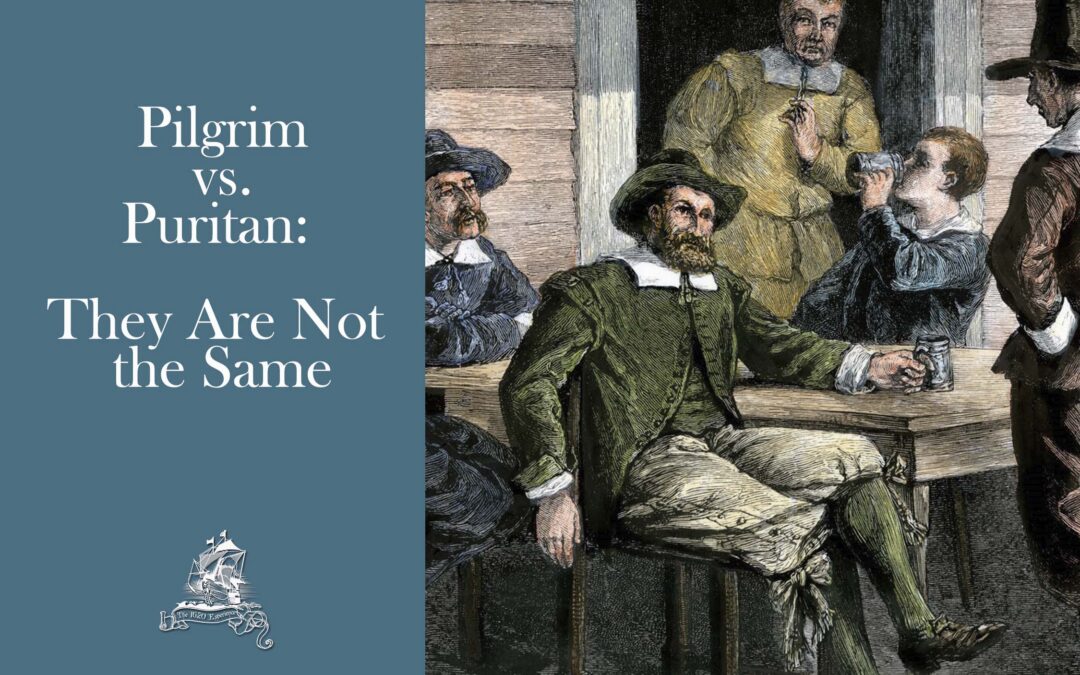
Can You Tell a Pilgrim From a Puritan by His Clothes?
Probably not.
This is where popular history becomes particularly entertaining. If you imagine Pilgrims in plain black clothing while Puritans wore something different, the historical evidence doesn’t support that distinction.
Pilgrims dressed like English men and women of their era and social circumstances.
The Mayflower Society’s clothing research shows that Pilgrim wardrobes included violet, blue, green and red. Wool and linen were basic clothing fabrics, while silk was available for finer garments. Cotton existed but was rare and expensive. Deep, rich black was itself expensive—not the obvious uniform of humble religious settlers. William Bradford’s own estate inventory included a green gown and an old violet-colored cloak, alongside garments described as black, light-colored, lead-colored and other shades.
Clothing therefore gives us an important correction: Pilgrim and Puritan were religious and historical distinctions—not competing fashion brands.
So What’s the Simplest Way to Remember the Difference?
Try this:
- Puritans wanted further reform of the Church of England.
- The Pilgrims concluded that separation from it was necessary.
That difference helps explain why the Pilgrims became religious refugees, why they fled to Holland, why their congregation developed its own leadership structure, and why church community remained so central when they established Plymouth. But don’t erase what the groups shared.
Both arose from the turbulent world of English Protestant reform. Both emphasized Scripture. Both wrestled with questions of church authority, worship and Christian community. And once established in New England, their histories increasingly intersected. The Pilgrims were not simply “the nice Puritans.” The Puritans were not simply “Pilgrims who arrived ten years later.” The real history is much more interesting. And understanding the difference helps us see the Pilgrims not as Thanksgiving characters in black hats, but as what they actually were:
A small group of English Separatists whose convictions about Scripture, worship, authority and the nature of the church were strong enough to send them first across the North Sea—and eventually across the Atlantic.
The strongest references for this article are Pilgrim Hall Museum — Separatist Religious Beliefs, Pilgrim Hall Museum — Pilgrim and Puritan: A Delicate Distinction, Mayflower Society — When Is a Puritan Not a Puritan?, and Mayflower Society — Dress Like a Pilgrim. Those four alone document most of the distinctions in the article.
However, other articles that were drawn upon include:
Pilgrim Hall Museum — Separatist Religious Beliefs
General Society of Mayflower Descendants — “When Is a Puritan Not a Puritan?”
Pilgrim Hall Museum — Richard Clyfton: First Pastor to the Pilgrims
Pilgrim Hall Museum — William Bradford’s Will and Inventory
General Society of Mayflower Descendants — Dress Like a Pilgrim
Pilgrim Hall Museum — William Brewster
Pilgrim Hall Museum — Mayflower Pilgrims
Pilgrim Hall Museum — In Bradford’s Words
Pilgrim Hall Museum — Religion & Worship
Pilgrim Hall Museum — Plymouth Colony
The image on the cover is titled, “Puritans-drinking-from-pewter-mugs-in-colonial-massachusetts.” Sourced from Wikimedia Public Domain Images. Author unknown.
Recent Comments