
Set the oven to 350 degrees. Take the chicken from the refrigerator. Simmer for twenty minutes.
Three perfectly ordinary cooking instructions—and none of them would have made much sense in an early Plymouth kitchen. There was no thermostat. There was no refrigerator. And there certainly wasn’t a grocery store waiting when an ingredient ran out.
Cooking in Plymouth began long before a pot was placed over the fire. Someone had to plant, harvest, hunt, fish, gather, preserve or trade for the food. Firewood had to be obtained. Grain might have to be pounded or ground. Water had to be carried. And the cook had to control heat by experience rather than by turning a dial.
Perhaps the biggest difference between our kitchen and theirs is this: Today, cooking begins when we open the refrigerator. In Plymouth, getting food to the kitchen was part of cooking.
Your Most Important Appliance Was Fire
The center of the early Plymouth kitchen was the hearth. Fire supplied the heat for cooking and helped warm the house. That meant preparing dinner required an ability many of us no longer possess: managing fire.
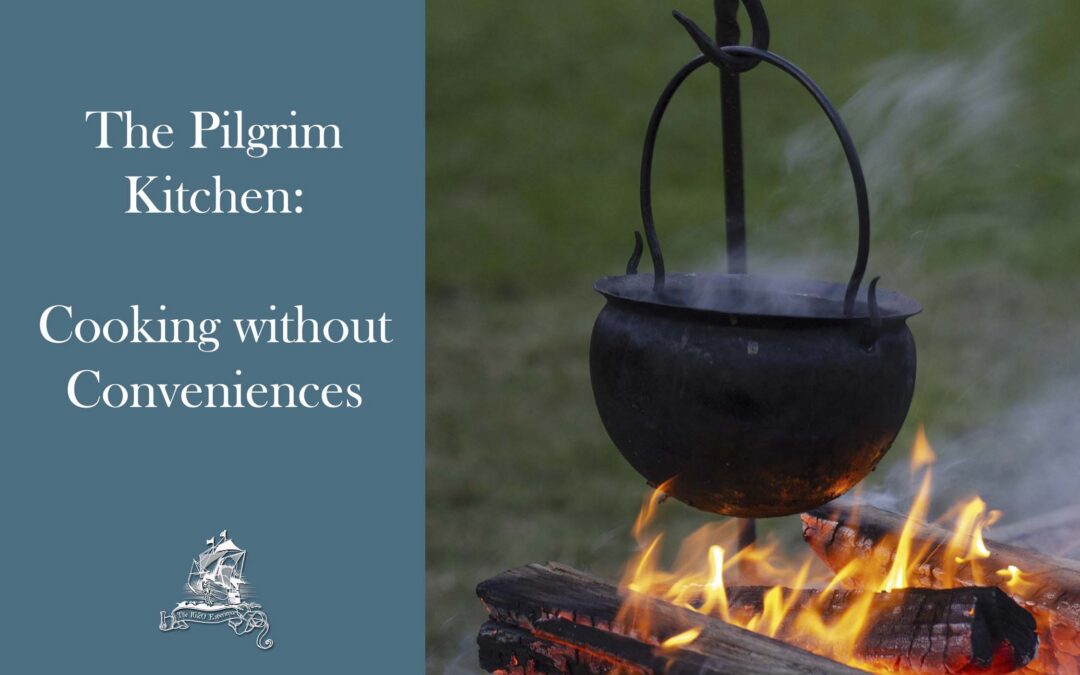
There was no button to turn it on. Fuel had to be gathered and stored. A fire had to be established and maintained. The cook controlled heat through such things as the size and condition of the fire, the arrangement of coals, and the placement of cooking vessels. Pilgrim Hall Museum’s collection includes an iron cooking pot traditionally associated with Myles Standish. Made in seventeenth-century England, it originally had long feet so it could stand directly over a fire.
Iron cookware mattered enough that prospective colonists were specifically advised to bring it. Early provisions lists include pots, kettles, skillets and frying pans among the equipment settlers needed. A cooking pot wasn’t a kitchen accessory. It was infrastructure.
Dinner Often Began With a Pot
One of the most practical forms of cooking was pottage. Rather than thinking of pottage as one particular recipe, imagine a broad category of soups, porridges and stews. Grain, vegetables, herbs, meat or whatever else was available could be cooked together in liquid. This was particularly practical in a world where ingredients varied with season and availability. And we have a wonderful firsthand Plymouth example.
In 1623, Edward Winslow visited Ousamequin—the Wampanoag sachem the English called Massasoit—when he was seriously ill. Winslow was asked to prepare something for him to eat. Winslow decided to make an English-style pottage. There was just one problem. He didn’t have the ingredients he wanted. So he improvised.
Pilgrim Hall’s foodways research reproduces Winslow’s description. He had a Wampanoag woman bruise corn, boiled it in a pot, searched for herbs, added strawberry leaves and flavored the mixture with a little sassafras root. Ousamequin drank the resulting broth. It is an extraordinary little moment in culinary history: an English colonist attempting a familiar kind of dish using American corn and locally available plants. And it illustrates one of the fundamental rules of the Plymouth kitchen: Cook with what you have.
Corn Changed Everything
No discussion of Plymouth cooking can ignore maize—what English colonists called Indian corn. Corn was unfamiliar to English settlers as a staple grain. Indigenous peoples of the Americas had cultivated and prepared maize for generations, and English colonists gradually learned to incorporate it into their own diets.
Pilgrim Hall brings together several early descriptions of Indigenous corn preparation. Corn could be parched and ground into meal. It could be pounded and boiled into porridge. Finely ground corn could be mixed with water and made into cakes that were cooked in hot ashes.
English colonists eventually adapted some of these foods according to their own tastes. Roger Williams later described samp, made from beaten corn boiled for a long period. He observed that English people ate it hot or cold and might add milk or butter. That seemingly small addition tells a larger story. The colonists did not simply reproduce an English diet in America. They couldn’t. Instead, they gradually learned to cook American ingredients using a mixture of Indigenous knowledge and English culinary habits.
Corn became colonial food.
Before Cooking Corn, Somebody Had to Process It
A bag of cornmeal did not arrive from the supermarket. Turning corn into something suitable for cooking required labor. Corn could be dried, parched, pounded or ground depending upon the intended preparation. Early accounts cited by Pilgrim Hall describe wooden mortars used to pound corn into meal. That labor changes the meaning of a simple bowl of porridge.
Before anyone stirred the pot, someone had planted the corn. Someone tended it. Someone harvested it. Someone dried or stored it. Someone processed it. Someone obtained the water. Someone collected fuel. Then someone cooked it.
Our modern word “recipe” captures only the final part of that process.
Your Refrigerator Was the Season
The Plymouth household couldn’t expect strawberries in January or fresh corn whenever someone wanted it. Food availability followed the land. Fish had seasons. Wild birds had seasons. Crops had growing and harvest cycles. Wild fruits, nuts and plants became available at particular times. That made preserving and storing food essential.
Pilgrim Hall’s food research documents corn as a particularly important stored food. Bradford described supplies of corn being distributed by allowance during periods of scarcity. He also recorded fish such as cod and bass, waterfowl, wild turkey and venison among the foods available to Plymouth colonists. The General Society of Mayflower Descendants likewise identifies corn, beans, squash and other locally available foods in its educational material on Pilgrim foodways.
The question wasn’t merely, “What sounds good tonight?” It was: What is available now—and what did we successfully preserve from before?
Preservation Wasn’t Optional
Without refrigeration, food preservation required other methods. Drying was particularly important. Corn could be dried for later use. Fish could be dried or salted. Meat could also be salted or otherwise preserved. Salt itself therefore mattered.
Early provisions lists advised emigrants to bring salt along with food staples and cooking equipment. And storage required planning. A good harvest did not automatically guarantee a good winter. Food had to remain edible after the harvest ended. Containers mattered. Moisture mattered. Spoilage mattered. Rodents mattered.
A household’s survival depended partly upon how well it managed the months between abundance and scarcity.
Cooking Was Household Labor
It is tempting to imagine “the Pilgrim cook” standing serenely beside a hearth. Real household food preparation involved much more labor. The General Society of Mayflower Descendants documents the enormous responsibilities carried by the surviving women after Plymouth’s first winter. Only five of the eighteen adult women who began the voyage survived into spring 1621. Those women took responsibility not only for their own households but also helped care for orphaned children and participated in agricultural work.
Bradford later recorded women going into the fields with their children to plant corn when Plymouth reorganized agricultural production in 1623. So the labor behind dinner did not begin at the hearth. Women and children could participate in agricultural and household work. Men hunted, fished and farmed. Household members processed ingredients and tended fires. Food connected nearly everyone’s work.
There Was No Standard Plymouth Cookbook
Here’s an important caution. We do not possess a cookbook telling us exactly how the Mayflower families prepared their everyday meals. Pilgrim Hall explicitly notes that no original menus or recipes survive from early Plymouth. Historians reconstruct foodways from Bradford and Winslow’s writings, inventories, archaeological evidence, contemporary English cookbooks and other seventeenth-century sources.
That means we should be skeptical when someone announces, “Here is the Pilgrims’ authentic recipe for ______.” Sometimes we know the ingredients available. Sometimes we know a particular dish existed. Occasionally we even have an eyewitness description, as with Winslow’s improvised pottage. But historical possibility and historical documentation are not the same thing.
Ironically, that uncertainty makes Plymouth’s food history more interesting—not less.
What Would Surprise Us Most?
Perhaps not the food. The work.
A modern cook can decide to make soup at 4:30 and have dinner on the table at 6:00. In Plymouth, that bowl might represent months of effort. Plant the crop. Tend it. Harvest it. Dry it. Store it. Pound the grain. Carry the water. Gather the wood. Build the fire. Control the heat. Cook the food. Wash the pot.
And tomorrow? Do much of it again.
There was no oven dial. No refrigerator. No grocery store. But the Pilgrim kitchen was not primitive in the sense of being thoughtless or unskilled. Quite the opposite. It required an extraordinary body of practical knowledge—knowledge of fire, food, seasons, preservation, agriculture and the properties of ingredients.
It also required adaptation.
English settlers arrived with familiar ways of cooking but encountered unfamiliar foods and an unfamiliar environment. Indigenous knowledge of maize and other local resources became part of the colonists’ developing food culture. The result was a kitchen neither entirely English nor Indigenous. It was becoming something new.
And every day, someone still had to answer the oldest household question in history: What are we going to make for dinner?
The single strongest source is Pilgrim Hall Museum — Plymouth Colony Menu and Foodways. It contains the primary-source material concerning corn preparation, samp, Winslow’s pottage, fish, fowl and other foods, while carefully distinguishing documented evidence from later reconstruction.
For cookware and the physical kitchen, use Pilgrim Hall Museum — It Came on the Mayflower and Pilgrim Hall Museum — Early Provisions Lists. For the human labor behind food production, General Society of Mayflower Descendants — Women of the Mayflower is particularly valuable.
Recent Comments